
Marrakesh Guide
A red-walled medina city where riads, souks and the Atlas Mountains sit a short drive apart.
Marrakesh splits cleanly into the old medina — a dense, car-free maze of souks, riads and the Jemaa el-Fnaa square — and the wider, modern Gueliz and Hivernage districts, which hold the newer restaurants, galleries and nightlife. Most first-time visitors underestimate how disorienting the medina's alleys are and how aggressively touts work near the main gates, so a riad host's directions or a local guide for the first walk pays off. Summer heat is severe by midday, and the call to prayer punctuates the day everywhere, including inside quieter riads.
Share this guide
Live from Marrakesh
Latest news & events
Fresh Marrakesh stories and events are on the way — check back soon.
The medina to the Atlas foothills, end to end
Illustrated
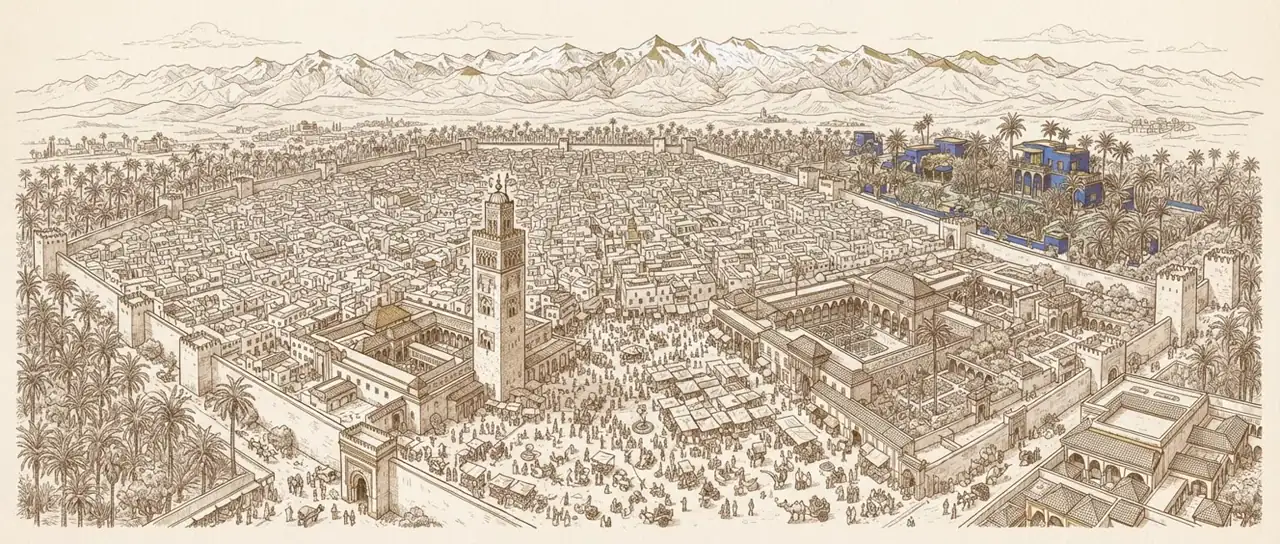
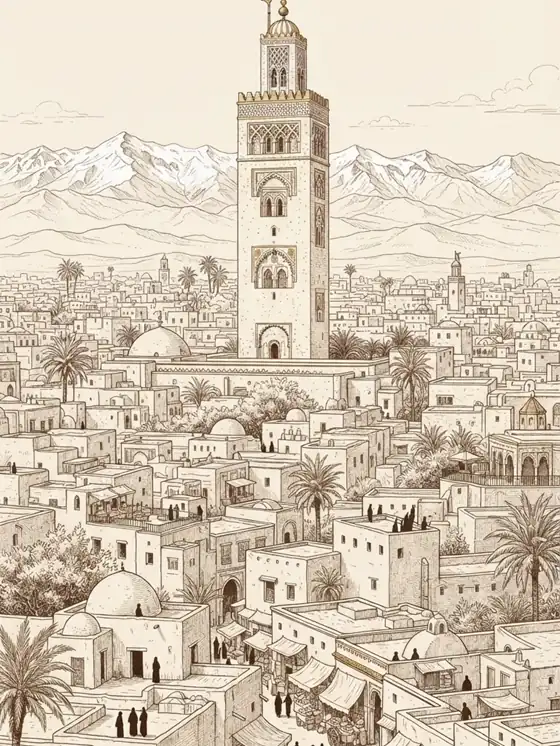
Drawn by hand for the KEY2 Marrakesh guide
Where to stay
Hotels
The KEY2 list
Happy Hour
Daylight
Hotel Pools & Pool Clubs
Eat
Best Food
Mornings
Breakfast & Brunch
Recover
Health & Wellness
After dark
Nightlife
Arenas
Sports
Tonight
Concerts & Comedy
Say it here
Weddings
Book the room
Event Spaces

Experiences
100 Other Things To Do
Marrakesh explained
Hour-by-hour plans drawn by hand — pick one and follow it from first coffee to last call.
24 Hours in Marrakesh
A tight loop through the medina's palaces, souks and a rooftop dinner over Jemaa el-Fnaa.
48 Hours in Marrakesh
Two days balancing the medina sights with the Atlas Mountains and a palace spa afternoon.
Marrakesh travel guide
The practical layer: when to come, how to arrive, how to move, where to base yourself and what it costs.
Best time to visit
March to May and October to November offer the mildest, most walkable weather; summer is workable but genuinely hot, and winter nights are colder than most visitors expect given the daytime sun.
Getting in
Marrakesh Menara Airport (RAK) sits about 15–20 minutes from the medina. A licensed petit taxi or hotel transfer runs roughly 100–150 MAD (around $10–15); agree the fare or confirm the meter before departing, as pricing is not always transparent.
Getting around
The medina itself is walked, not driven — its alleys are too narrow and dense for cars. Petit taxis (short orange cabs) cover trips between the medina, Gueliz and Hivernage cheaply if the meter is used; ride-hailing apps have limited coverage, so many visitors rely on their riad or hotel to arrange transfers instead.
What it costs
A mid-range riad runs $80–160 a night; dinner for two at a good restaurant costs $30–60; a short petit taxi ride across town typically costs 20–40 MAD (roughly $2–4) if the meter is used or the fare is agreed in advance.
Where to stay
- Medina
- The atmospheric choice — riads inside the walls, walking distance to Jemaa el-Fnaa and the souks, but noisier and harder for luggage and taxis to reach directly.
- Hivernage
- A leafy, hotel-and-nightclub district just outside the walls, home to La Mamounia and most large resort hotels.
- Gueliz
- The modern new town, with the city's contemporary restaurants, galleries and Jardin Majorelle, a short taxi ride from the medina.
- Palmeraie
- A palm-grove district north of the city with resort villas and golf courses, quieter but requiring a taxi for everything.
Traveller tips
- Agree taxi fares before getting in, or insist on the meter — overcharging tourists is common, especially from the airport and Jemaa el-Fnaa.
- Haggling is expected in the souks; starting around a third of the first quoted price is a reasonable opening move.
- Dress modestly outside hotel pools and resort grounds — shoulders and knees covered is the norm and reduces unwanted attention.
- Ask your riad for turn-by-turn directions or a pickup escort for your first walk in after dark; the medina's alleys are genuinely disorienting and mostly unnamed.
- Tipping (a few dirhams) is expected for guides, porters and hammam attendants, even when a service charge is not listed.
- Carry small-denomination dirhams — cash is preferred in the souks and by petit taxis, and ATMs inside the medina can run out on busy days.
The Marrakesh calendar
The dates that actually move prices, crowds and opening hours.
January
Marrakech Marathon
A late-January route through the medina walls and palm groves that closes several central streets to traffic for the morning.
April
Marrakech Biennale (in Biennale years)
Contemporary art and architecture exhibitions staged across palaces and galleries in the medina and Gueliz.
June
Popular Arts Festival
A week of folk music, dance and acrobatics staged at El Badi Palace, drawing troupes from across Morocco.
November
Marrakech International Film Festival
A week of premieres and red-carpet events centred on Jemaa el-Fnaa and the city's main hotels; rates rise sharply.
December
New Year in the medina
Jemaa el-Fnaa and riad rooftops fill for New Year's Eve; book restaurant tables and riad stays well ahead.
Seasonal highlights
- Spring (Mar–May)
- Mild, dry and the most comfortable season for walking the medina and day-tripping to the Atlas foothills.
- Summer (Jun–Aug)
- Very hot, regularly above 100°F by afternoon; riad courtyards and pools become essential, not optional.
- Autumn (Sep–Nov)
- Warm days and cool evenings return by October, with the Film Festival adding a late-November spike in demand.
- Winter (Dec–Feb)
- Mild by day but genuinely cold at night, since most medina riads have little central heating.
Off-peak intel
- Visit Jardin Majorelle and Bahia Palace right at opening to beat both the heat and the tour-bus crowds.
- March–April and October–November give the best weather-to-crowd balance outside the Film Festival week.
- July and August bring the lowest riad rates of the year, if you can handle the midday heat by staying poolside.
- Book a hammam or spa slot for the hottest part of the afternoon, when walking the souks is least appealing anyway.